
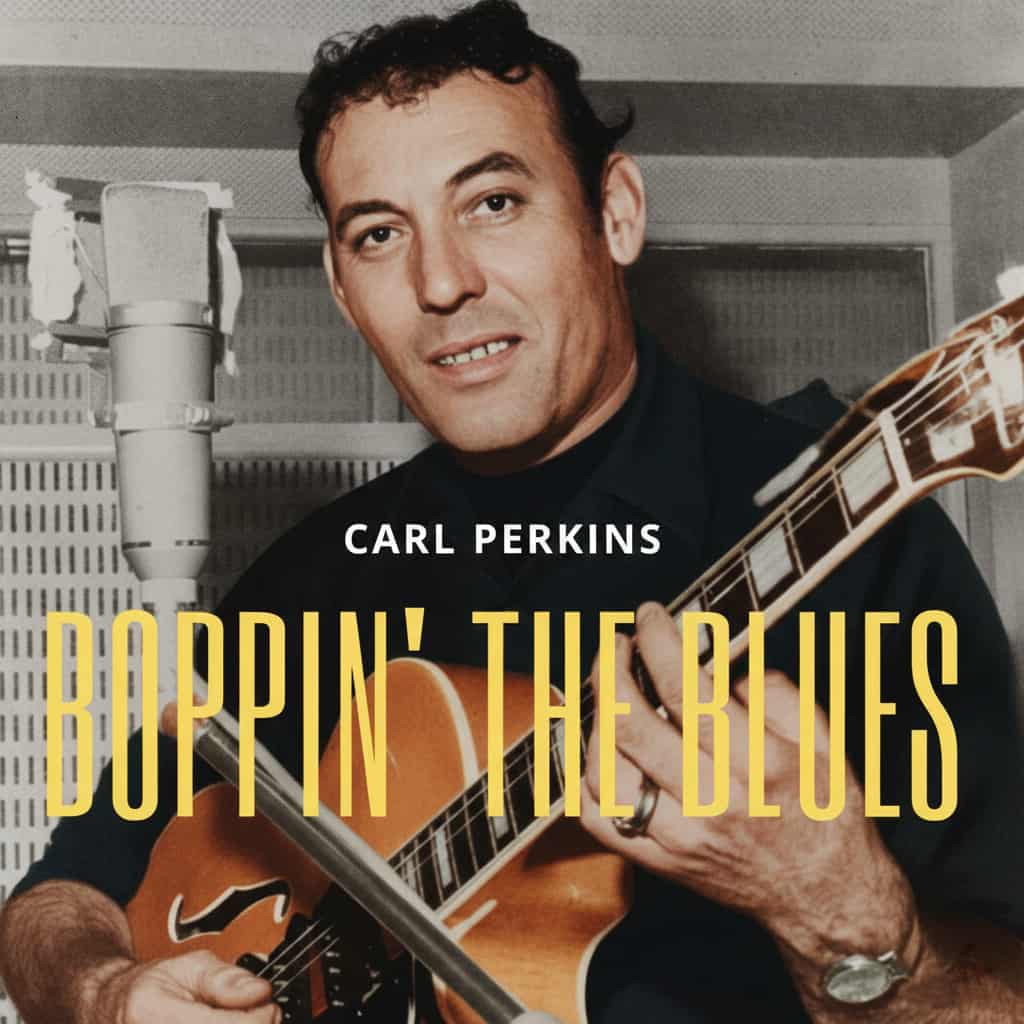
A jubilant declaration of rhythm over reason, where youthful rockabilly joy momentarily outpaces love, logic, and restraint.
Released in May 1956 on Sun Records, “Boppin’ the Blues” stands as one of the most exuberant early statements in Carl Perkins’ brief but incandescent first chapter in rock and roll history. Written by Carl Perkins alongside his longtime musical companion Howard “Curley” Griffin, the song arrived at a moment when American popular music was rapidly shedding its old skins. Rhythm and blues, country, and jump blues were colliding in Southern studios, and few places captured that energy more vividly than Sam Phillips’ Sun studio in Memphis.
Commercially, “Boppin’ the Blues” performed impressively upon its release, climbing to No. 7 on the Billboard pop chart, confirming Perkins as far more than a regional curiosity. Coming just months after the explosive success of “Blue Suede Shoes”, the single demonstrated that Perkins was not a one song phenomenon, but a writer and performer deeply attuned to the pulse of postwar youth culture.
Musically, the record is lean, fast, and joyful to the point of near abandon. From the opening line, the song announces its mission with a grin and a backbeat. Friends everywhere are “boppin’ the blues,” a phrase that neatly encapsulates the mid-1950s transformation of blues feeling into rock and roll movement. This is not sorrow expressed in lament, but restlessness converted into motion. The blues are no longer something to sit with. They are something to dance through.
The lyrics are playful, almost conversational, but beneath their humor lies a revealing portrait of the era’s emotional priorities. The narrator openly admits affection for his lover, yet repeatedly confesses that he is “rhythm bound.” This is not cruelty or indifference. It is a recognition that music itself has become an irresistible force, capable of overruling romance, routine, and even physical limitation. When the doctor’s advice is replaced by nickels for the jukebox, the song celebrates music as medicine, sound as salvation.
Perkins’ performance is central to the song’s enduring appeal. His vocal delivery is relaxed yet urgent, riding the rhythm with a natural ease that never sounds rehearsed. His guitar work, sharp and percussive, anticipates the rockabilly style that would soon influence generations of players. There is no excess here. Every note serves the groove, every lyric feeds the momentum.
What makes “Boppin’ the Blues” especially meaningful in hindsight is its sense of communal joy. The song does not isolate the experience of rhythm. It spreads it. Friends, cats, even grandparents are swept up in the same irresistible beat. When “grandpa Don” throws his crutches down, the moment borders on the surreal, yet it captures something profoundly true about the cultural shock of early rock and roll. Music was crossing age lines, loosening bodies, and challenging expectations in ways that felt almost miraculous.
Within Carl Perkins’ catalog, the song occupies a special place. It lacks the mythic symbolism of “Blue Suede Shoes”, but it compensates with warmth, humor, and human immediacy. It shows Perkins not as an icon, but as a young man exhilarated by sound, carried forward by rhythm, and fully alive in the moment.
Decades later, “Boppin’ the Blues” remains a vivid snapshot of a time when music felt newly dangerous and wonderfully liberating. It reminds listeners that before rock and roll became an industry, it was a feeling. A feeling strong enough to make love wait, strong enough to make pain disappear, and strong enough to get the whole room moving together, if only for three minutes on a spinning jukebox record.