
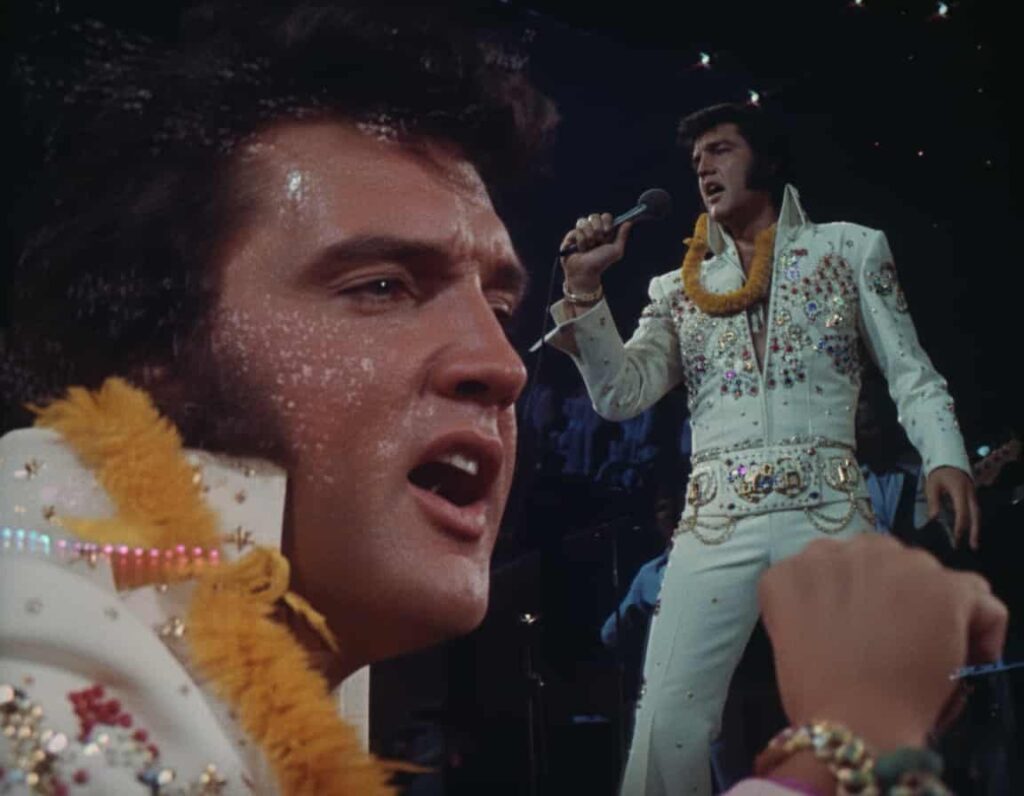
A Man Looking Back Without Apology, Singing a Final Accounting of His Life
When Elvis Presley stepped onto the stage at the Honolulu International Center on January 14, 1973, for Aloha From Hawaii via Satellite, the world was not simply witnessing a concert. It was watching an artist pause, look backward, and quietly measure the weight of his own life. Among the many songs that evening, “My Way” carried a gravity unlike anything else in the set. It was not shouted. It was not dramatized. It was delivered with restraint, dignity, and a sense of reckoning that felt deeply personal.
Originally written in French as “Comme d’habitude” by Claude François and Jacques Revaux, and later adapted into English by Paul Anka, “My Way” had already become inseparable from Frank Sinatra, who turned it into a defining statement in 1969. Elvis, however, approached the song from a different place. By 1973, he had little left to prove. He had conquered radio, film, television, and the live stage. What remained was truth. And in this performance, truth was exactly what he offered.
The Aloha From Hawaii special itself was historic. Broadcast live via satellite to over 40 countries, it reached an estimated audience of more than one billion people, making it one of the most-watched television events of its era. The accompanying album, Aloha From Hawaii via Satellite, debuted at No. 1 on the Billboard Top LPs chart, reaffirming Elvis’s global stature at a time when popular music was rapidly changing. Within that monumental context, “My Way” stood apart as a moment of reflection rather than spectacle.
Elvis had first begun performing “My Way” in the early 1970s, but the Aloha rendition is widely regarded as definitive. His voice, no longer youthful or effortless, carried a weathered authority. Each line sounded lived-in. When he sang of having “faced it all,” it did not feel rhetorical. It felt earned. There was no attempt to imitate Sinatra’s bravado. Elvis softened the song, turning it inward. The phrasing was slower, the pauses heavier, the silences just as meaningful as the words.
Although the live recording of “My Way” from this era was released as a single later in the decade, it achieved notable chart success, reaching No. 22 on the Billboard Hot 100 and No. 8 on the Adult Contemporary chart in 1978. In the United Kingdom, it climbed into the Top 10. These numbers matter, but not as much as the reason the song endured. Listeners recognized something honest in Elvis’s delivery. It sounded like a man taking responsibility for his choices, both the triumphs and the mistakes.
What makes “My Way” so powerful in Elvis’s hands is its quiet defiance. This was not a boast. It was a statement of survival. By 1973, Elvis was aware of the criticisms, the jokes, the rumors. He knew how the narrative around him had shifted. Yet in this performance, there is no bitterness. Only acceptance. The song becomes less about independence and more about ownership. A life, imperfect but fully lived.
The orchestration during the Aloha performance supports this interpretation. The arrangement is stately, almost ceremonial, allowing Elvis’s voice to remain at the center. The famous white jumpsuit, adorned with the American eagle, added visual symbolism, but it was the stillness in his posture that truly defined the moment. He stood grounded, singing as if addressing himself rather than the crowd.
Over time, “My Way” has come to feel prophetic within Elvis’s catalog. It was not a farewell by design, but history has turned it into one. Today, it is often remembered as one of the clearest windows into who Elvis was in his later years. A man aware of his legacy, conscious of time, and unwilling to apologize for the road he traveled.
In the end, Elvis Presley’s “My Way” from Aloha From Hawaii is not merely a cover of a famous song. It is a self-portrait. One painted with restraint, humility, and quiet strength. It reminds us that true greatness is not always found in reinvention, but in the courage to stand still, look back, and say, without regret, that the journey was lived honestly.
 Oldies Songs