
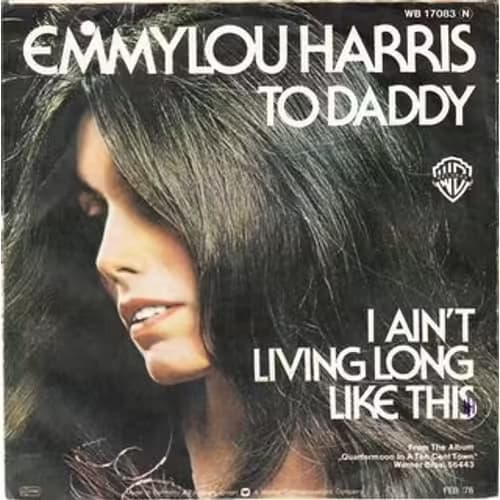
A restless spirit refusing to bow to hardship, carried in a voice that turned defiance into quiet grace.
When Emmylou Harris included “I Ain’t Living Long Like This” on her 1978 album “Quarter Moon in a Ten Cent Town,” she was not chasing chart positions or looking for a commercial breakthrough. In fact, her rendition was never released as a single and therefore did not enter the major charts. But its importance lies elsewhere. The song, written by Rodney Crowell and first recorded by Gary Stewart in 1977, was a piece of rugged, lived-in songwriting that resonated deeply with the restless edge of American life. And when Emmylou carried it into her own world of shimmering harmonies and emotional intelligence, she revealed the lyric’s bruised humanity with a tenderness that few singers could summon. The song later became a No.1 country hit for Waylon Jennings in 1979, but Emmylou’s version was the one that subtly anchored it in the consciousness of listeners who gravitated toward songs of struggle, perseverance, and moral weariness.
Crowell wrote “I Ain’t Living Long Like This” from a collage of memories, stories, and the emotional truth of those who lived too close to danger, temptation, and bad luck. It was never a glamorization of outlaw life. Instead, it was a portrait of someone standing on the edge, too tired to keep running yet too proud to fall apart. That quiet ache—something deeper and more existential than mere rebellion—was what Emmylou understood. Her voice had always carried the soft weight of sorrow, memory, and empathy. In this recording, she leaned into the song’s weary resolve, smoothing its rough outlines without diminishing the pain that shaped it.
“Quarter Moon in a Ten Cent Town” arrived at a pivotal point in her artistic life. It was an album that expanded her musical palette—still rooted in traditional country, but increasingly drawing from folk, rock, and songwriter-driven narratives. Her choice to interpret Crowell’s composition was both personal and artistic: she had long championed his writing, and she possessed the rare ability to make any lyric feel as though she had lived it herself. Even when she sang of jailhouse walls, bad decisions, and impossible escapes, the emotional truth remained universal. It spoke to anyone who had ever felt trapped by circumstance, worn down by time, or cornered by the disappointments that accumulate quietly in life’s shadowed spaces.
What gives Emmylou’s interpretation its lingering power is the way she reframes the song’s rebellion. Where other singers delivered it with grit and swagger, she offered reflection—an inward reckoning instead of an outward shout. Her voice, illuminated by the elegant production that defined her 1970s work, turns the song into a quiet confession: the admission that life can press too hard, that fatigue can run bone-deep, and that everyone, at some point, contemplates the distance between who they hoped to be and who they have become.
For many listeners, the song became a reminder of younger years—of roads taken and roads avoided, of mistakes survived, and of the way music can gather all those scattered pieces into something that feels whole again. Emmylou’s gift has always been this ability to meet the listener where memory lives, not with judgment but with understanding.
Her rendition of “I Ain’t Living Long Like This” endures because it honors the truth inside Crowell’s writing: that defiance is often just another word for endurance, and that even the most restless souls long for a place where the running finally stops.
 Oldies Songs