
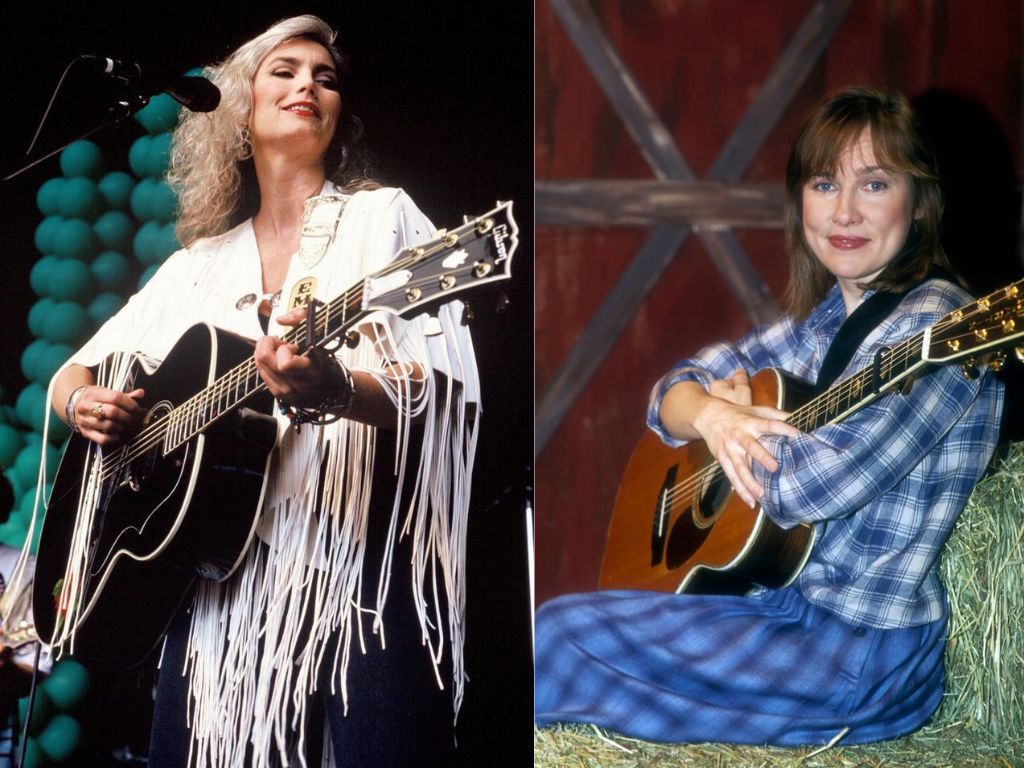
Wildwood Flower — a timeless folk hymn where two kindred voices return to the roots of memory
When Emmylou Harris and Iris DeMent sing “Wildwood Flower,” it feels less like a performance and more like a homecoming. This is not a song that arrives with urgency or ambition; it drifts in gently, like a familiar scent carried on evening air. Their version appears on Emmylou Harris’s 2008 album All I Intended to Be, a record that marked a deeply reflective and quietly triumphant chapter in her later career. While “Wildwood Flower” itself was not released as a single and did not chart independently, the album reached No. 22 on the Billboard 200 and No. 5 on the Top Country Albums chart upon release — a testament to the enduring respect Harris commanded decades into her journey.
The song’s history stretches far back beyond either singer. “Wildwood Flower” is one of the most enduring standards in American folk and country music, popularized in the late 1920s by The Carter Family. Its melody traces back to the 19th-century parlor song “I’ll Twine ’Mid the Ringlets,” composed by Joseph Philbrick Webster, with lyrics later reshaped into the version that became known worldwide. Over time, the song transformed into something communal — passed from voice to voice, generation to generation, until authorship mattered less than feeling.
That sense of inheritance is precisely what gives this rendition its power.
Emmylou Harris has always been a guardian of musical memory — someone who carries the past forward without embalming it. Iris DeMent, with her unvarnished, tremulous voice, brings a complementary truthfulness that feels almost conversational. Together, they strip “Wildwood Flower” down to its emotional bones. There is no ornament here, no attempt to modernize or embellish. What remains is devotion — to the song, to tradition, and to the quiet dignity of restraint.
The lyrics speak of love remembered, beauty faded, and a heart left waiting among the ruins of time. Lines about wildwood flowers, scattered leaves, and lost devotion feel deceptively simple, yet they carry the weight of lives fully lived. In the hands of younger voices, the song can sound like a story being told. In the voices of Harris and DeMent, it sounds like a memory being revisited — slowly, carefully, with respect for what once was.
There is something profoundly moving in the way their voices meet. Harris sings with her familiar clarity, slightly weathered now, every note measured and thoughtful. DeMent’s voice, fragile yet fearless, leans into the cracks where emotion lives. When they harmonize, it is not about blending perfectly; it is about coexistence. Two distinct lives, two distinct paths, momentarily aligned in shared understanding.
Within All I Intended to Be, this track feels like a spiritual pause. The album itself was a return after years of loss and change, shaped by themes of reflection, resilience, and acceptance. “Wildwood Flower” fits naturally into that landscape — a song about love that once bloomed, now remembered with tenderness rather than regret. It does not ask to be mourned. It asks to be honored.
For listeners who have watched the years pass — who have loved deeply, lost quietly, and learned to carry both — this version of “Wildwood Flower” resonates on a personal level. It reminds us that some songs do not belong to a single era. They belong to moments: a voice on the radio late at night, a record spinning softly, a memory stirred without warning.
In the end, this collaboration is not about nostalgia as sentimentality. It is nostalgia as wisdom. Emmylou Harris and Iris DeMent do not sing of the past to escape the present; they sing to make sense of it. And in doing so, they remind us that even as petals fall and seasons change, the flower — once known, once loved — never truly disappears.
 Oldies Songs