
A Gentle Ascent to Memory and Grace, Where a Familiar Hill Still Blooms in Song
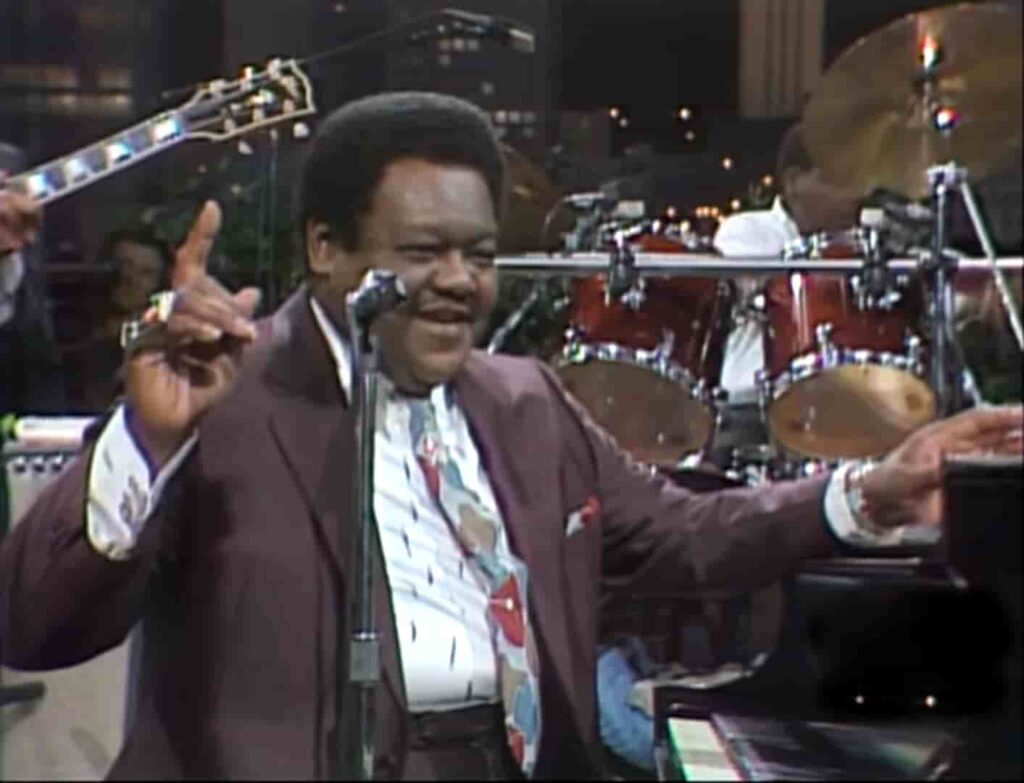
When Fats Domino stepped onto the modest stage of Austin City Limits to perform “Blueberry Hill”, the moment carried far more weight than a routine television appearance. By then, the song was already three decades old, yet its emotional gravity remained intact, even deepened. First recorded by Domino in 1956 and released as a single on Imperial Records, “Blueberry Hill” became the defining record of his career. It reached No. 2 on the Billboard Top 100, held No. 1 on the R&B chart for eleven consecutive weeks, and later anchored the influential album This Is Fats Domino! These are the hard facts, but they only begin to explain why this performance mattered.
The song itself was not new when Domino recorded it. “Blueberry Hill” had been written in 1940 by Vincent Rose, Larry Stock, and Al Lewis, and had already traveled through big band and crooner interpretations. What Domino did was quietly revolutionary. Guided by producer Dave Bartholomew, he slowed the tempo, softened the delivery, and wrapped the melody in the unmistakable warmth of his New Orleans piano style. The lyrics remained simple, even plain, but the feeling changed entirely. In Domino’s hands, the song stopped being nostalgic sentiment and became lived experience.
By the time Austin City Limits welcomed him in the mid 1980s, Fats Domino was no longer a chart contender, but something more enduring. He was a living bridge to the origins of rock and roll. Seated at the piano, smiling shyly, dressed without spectacle, he performed “Blueberry Hill” as if revisiting an old neighborhood rather than a famous song. The audience did not need instruction. Many had carried this melody through marriages, separations, wartime radio broadcasts, long drives, and quiet evenings at home. The song had aged with them.
What made this performance especially resonant was its restraint. Domino did not embellish or modernize the arrangement. The tempo stayed unhurried. His voice, weathered by time, no longer aimed for polish. Instead, it carried texture and truth. Each phrase felt measured, not for effect, but for memory. The line about finding a thrill on Blueberry Hill no longer sounded like youthful promise. It sounded like remembrance, gentle and accepting.
The meaning of “Blueberry Hill” has always rested in its emotional accessibility. It speaks of love found and love lost without drama or bitterness. There is no accusation, no moral lesson, only the quiet acknowledgment that happiness once existed and may not return in the same form. In the Austin City Limits performance, that meaning matured. The song became less about romantic loss and more about time itself. About places that remain vivid even when life has moved on.
Fats Domino had never claimed the spotlight with bravado. Unlike many of his contemporaries, he avoided controversy and self mythologizing. His influence, however, was enormous. Artists from Elvis Presley to Paul McCartney openly credited him as foundational. Yet on that stage, none of that mattered. What mattered was the song, the piano, and the shared understanding between performer and audience.
In the broader history of Austin City Limits, a program known for honoring authenticity over spectacle, this performance stands as a quiet high point. It reminded viewers that greatness does not require reinvention. Sometimes it requires only honesty and continuity. “Blueberry Hill” did not belong to the past in that moment. It existed fully in the present, carried by a man who had lived inside it for most of his life.
Long after the cameras stopped rolling, the image lingered. A modest stage. A familiar melody. A voice that had lost none of its kindness. For those who listened, “Blueberry Hill” was no longer just a hit record or a chapter in music history. It was a place remembered, still standing, waiting patiently for anyone willing to return.