
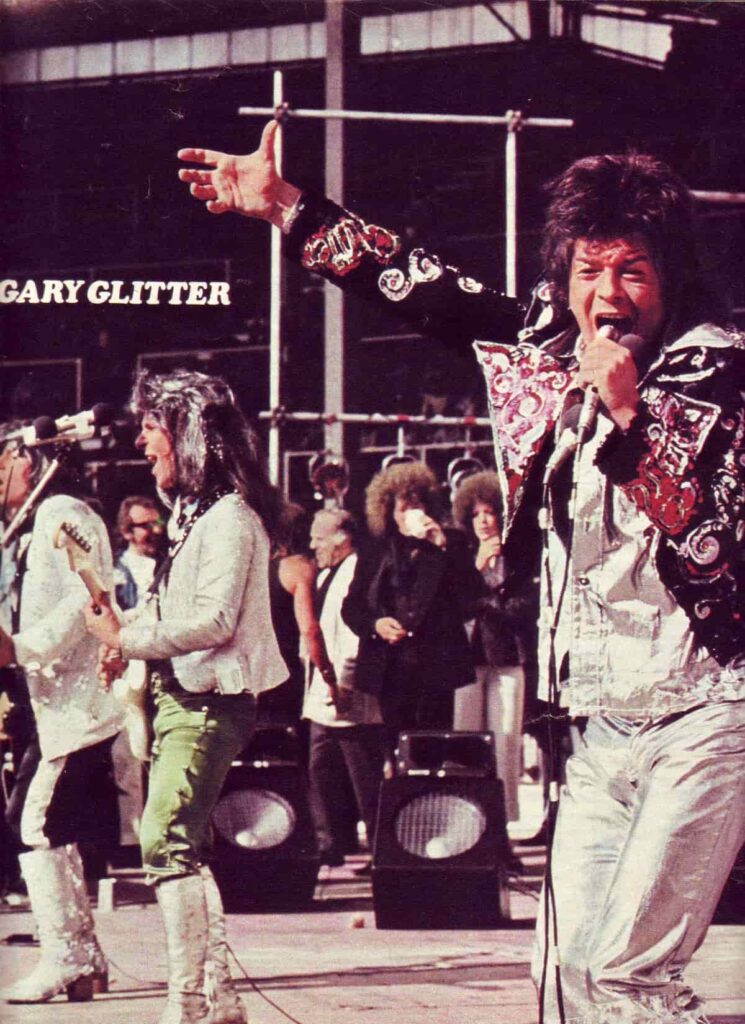
I Love You Love Me Love — a glittering anthem of desire, rhythm, and the raw pulse of early-70s rock euphoria
Few songs capture the pounding heartbeat of early-1970s glam rock as vividly as “I Love You Love Me Love” by Gary Glitter. Released in 1973, the song burst onto the airwaves with stomping drums, hand-claps, and an irresistible chant-like chorus that felt larger than life. Almost immediately, it struck a nerve. Upon its release, “I Love You Love Me Love” climbed to No. 1 on the UK Singles Chart, where it remained at the top for four consecutive weeks, confirming Glitter as one of the defining hitmakers of the glam rock era. Internationally, the song also reached No. 1 in several countries and broke into the American market, peaking at No. 44 on the Billboard Hot 100 — a notable achievement for a sound that was unapologetically British.
The track later became the opening song on the album Touch Me, also released in 1973, an album that consolidated Gary Glitter’s image: bold, brash, theatrical, and driven by rhythm rather than subtlety. At a time when rock music was splintering into many directions — progressive, folk, heavy blues — glam rock offered something different. It was physical. It was immediate. It demanded movement. And “I Love You Love Me Love” delivered exactly that.
Behind the song lies a simple but effective idea. Co-written by Gary Glitter and producer Mike Leander, the track is built not around poetic complexity, but around repetition and insistence. The lyrics are direct, almost primitive in their emotional language: love as desire, love as urgency, love as a chant shouted into the night. This simplicity was not a weakness — it was the very source of the song’s power. In an era before digital polish, the production leaned heavily on pounding drums, echoing vocals, and a relentless beat that felt tailor-made for arenas, dance halls, and crowded living rooms alike.
Yet beneath the glitter and stomp, the song also reflects something deeper about its time. The early 1970s were years of transition — socially, culturally, emotionally. After the idealism of the late 1960s, audiences were hungry for release rather than reflection. “I Love You Love Me Love” didn’t ask listeners to think; it invited them to feel. To clap along. To shout back. To lose themselves in repetition and rhythm. In that sense, the song functioned almost like a ritual — communal, physical, unifying.
For listeners encountering the song decades later, its impact can feel layered with memory. The sound instantly evokes a world of vinyl singles, bold stage costumes, platform shoes, and a time when pop music embraced spectacle without irony. Gary Glitter’s vocal delivery — half-sung, half-shouted — carries a raw confidence that feels inseparable from that era. It is the sound of a performer who knew exactly how to command attention, not through nuance, but through sheer force of presence.
Importantly, the song’s enduring recognition has little to do with lyrical depth and everything to do with atmosphere. “I Love You Love Me Love” survives because it captures a feeling — the thrill of youth, the electricity of loud music, the joy of losing oneself in sound. For those who lived through that period, the opening drumbeat can instantly transport them back to crowded dance floors, late-night radio shows, and a world that felt louder, bolder, and strangely simpler.
Separated from biography and controversy, the song stands as a document of its time — a reminder of when glam rock ruled the charts and pop music was unashamedly physical. “I Love You Love Me Love” may not whisper to the listener; it shouts, stomps, and claps its way into memory. And once it’s there, it never quite leaves.
In the long echo of popular music history, this song remains a glitter-streaked snapshot of an era when love was chanted, rhythm was king, and rock music asked only one thing in return: that you feel it.