
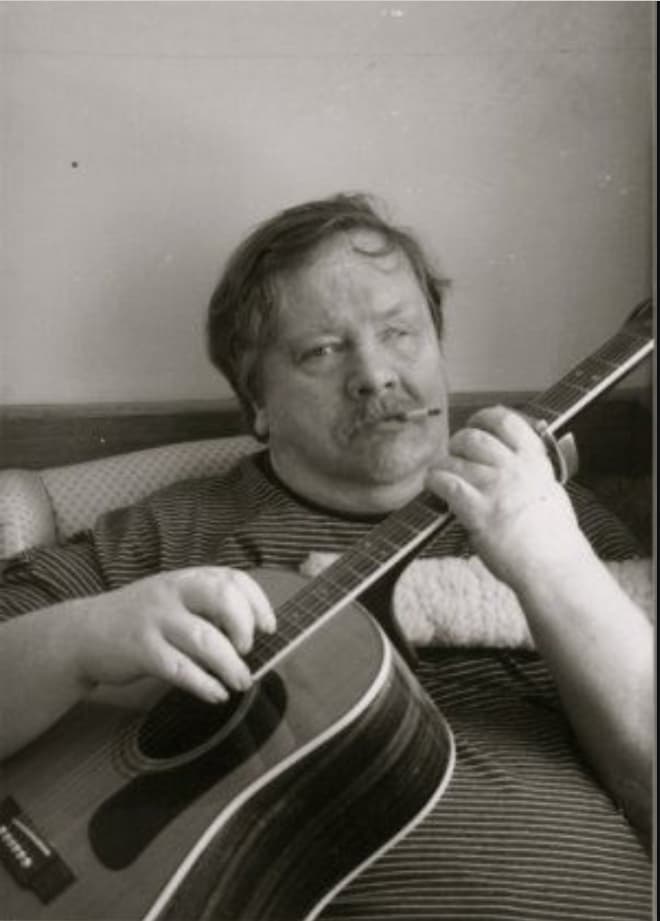
Milk and Honey — a fragile hymn to innocence, exile, and the quiet hope of belonging
From its opening lines, “Milk and Honey” feels less like a song and more like a whispered prayer. Written and recorded by Jackson C. Frank, it stands as one of the most haunting folk compositions of the 1960s — a piece shaped by trauma, displacement, and a lifelong search for peace. The song appeared on his only studio album, Jackson C. Frank, released in 1965 in the United Kingdom. The album did not register on the major charts at the time, but history has been far kinder to it than the charts ever were. Today, Milk and Honey is regarded as one of the quiet cornerstones of modern folk music.
The story behind the song cannot be separated from the life of its author. Jackson C. Frank was marked early by tragedy. As a child, he survived a devastating school fire in New York that killed many of his classmates. The physical and emotional scars from that event followed him throughout his life, shaping both his worldview and his art. When he later traveled to London in the mid-1960s, he carried with him not ambition in the conventional sense, but a collection of songs that felt more like confessions than compositions.
It was in this setting that Milk and Honey emerged. Produced by Paul Simon, the album captured Frank at his most exposed — a young man singing with an older soul. The song itself borrows its imagery from biblical language, where “milk and honey” symbolize a promised land, a place of abundance, rest, and belonging. Yet in Frank’s hands, the phrase becomes something more fragile. It is not a destination reached, but a dream glimpsed from afar.
Lyrically, Milk and Honey speaks of leaving one place for another, of searching for warmth, meaning, and refuge. There is no triumph in the journey — only movement. The voice that sings these words is steady but distant, as if already half-removed from the world it describes. Frank’s vocal delivery is strikingly restrained, almost withdrawn, and that restraint is precisely what gives the song its emotional power. He does not ask for sympathy. He simply tells the truth as he knows it.
Though the song never enjoyed commercial success upon release, its influence traveled quietly through the folk community. Over the years, “Milk and Honey” has been covered and performed by artists deeply attuned to its spirit, including Nick Drake, Sandy Denny, Fairport Convention, and Bert Jansch. Each interpretation carries the same reverence, as though the song demands gentleness from anyone who touches it. Few songs have inspired such devotion without ever belonging to the mainstream.
What makes Milk and Honey endure is its honesty. There is no pose, no polish, no attempt to reassure the listener. Instead, it offers companionship in uncertainty. For those who have lived long enough to know that life rarely unfolds as promised, the song feels painfully familiar. It understands the ache of searching — not just for success or love, but for a sense of home that may never fully exist.
Jackson C. Frank’s life after this recording was marked by instability, poverty, and illness. He would never release another official studio album, and for many years he drifted into near-total obscurity. Yet Milk and Honey remains, quietly defying that silence. It is the sound of a man leaving something behind without knowing where he will land — and trusting the song itself to carry the weight of that uncertainty.
Listening to it now, decades later, the song feels timeless. It speaks to anyone who has packed up their past and stepped into the unknown, hoping that somewhere ahead there might be gentler days. Not guaranteed happiness — just peace. And in that fragile hope, “Milk and Honey” continues to offer what Jackson C. Frank himself so rarely found: a place, however fleeting, where the soul can rest.