
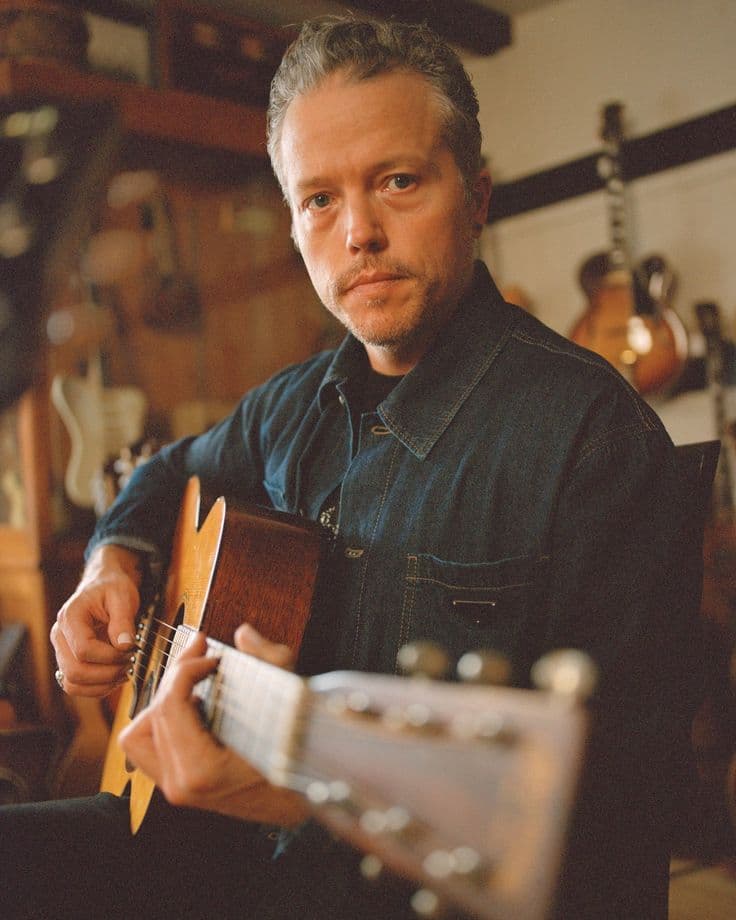
A raw confession of love, addiction, and redemption, where devotion becomes a fragile promise and memory becomes both shelter and wound.
Few modern American songs have aged into quiet classics as naturally as “Cover Me Up” by Jason Isbell. First released in 2013 on the album Southeastern, the song did not enter the world with chart fireworks or radio saturation. It did not debut on the Billboard Hot 100, nor was it designed as a commercial single at the time of its release. And yet, over the years, it has grown into something far more enduring than a hit: a confessional hymn for adults who have lived, lost, fallen apart, and tried—sometimes painfully—to put themselves back together.
What makes “Cover Me Up” remarkable is not where it stood on the charts when it arrived, but where it has settled in the hearts of listeners. In retrospect, its cultural impact has far outpaced its initial commercial footprint. Today, it is widely regarded as one of Jason Isbell’s signature songs and one of the most emotionally honest compositions in contemporary Americana and folk-inflected country music.
At the center of the song lies a deeply personal story. Jason Isbell wrote “Cover Me Up” during a turning point in his life, when he was confronting alcoholism and beginning the long, uncertain path toward sobriety. The song is intimately tied to his relationship with Amanda Shires, who would later become his wife. Rather than romanticizing struggle, Isbell places the listener directly inside it—raw, unguarded, and unresolved. Love here is not portrayed as rescue, but as responsibility. It is not a cure, but a commitment to stay present when escape feels easier.
Musically, the song is deceptively simple. Built around acoustic guitar and restrained phrasing, it leaves wide spaces for the words to breathe. Isbell’s vocal delivery is measured, almost hesitant, as if each line must be tested before it is allowed to exist. This restraint gives the song its gravity. There is no performance excess, no attempt to impress—only the quiet weight of truth being spoken aloud.
Lyrically, “Cover Me Up” is steeped in imagery that feels lived-in rather than poetic for its own sake. References to old scars, shared beds, and the ache of memory are not decorative; they are functional. The song understands that for adults, love is often intertwined with regret and recovery. The past is not erased—it is acknowledged, carried forward, and sometimes forgiven, but never forgotten. When Isbell sings about being “covered up,” it is not merely physical warmth he seeks, but protection from his own worst instincts.
The album Southeastern, on which the song appears, marked a career rebirth for Jason Isbell. After his departure from the Drive-By Truckers, many wondered whether he could step out of the shadow of a celebrated band and stand alone. With this record, and especially with “Cover Me Up,” he answered that question definitively. The album received widespread critical acclaim and is now considered a landmark work in modern roots music.
Years later, the song reached a wider commercial audience through a cover version by Morgan Wallen, released in 2021. That rendition climbed into the top 20 of the Billboard Hot 100 and topped the Hot Country Songs chart, introducing “Cover Me Up” to a new generation. Yet for many longtime listeners, the original remains definitive—not because it is more polished, but because it sounds like a man telling the truth to himself in real time.
The enduring power of “Cover Me Up” lies in its refusal to offer easy comfort. It does not promise happy endings, only honesty. It understands that love, especially later in life, is often less about passion than perseverance. For listeners who have weathered long marriages, personal failures, or quiet battles no one else sees, the song resonates with a rare kind of dignity.
In the end, Jason Isbell did not write a hit record. He wrote a document of survival. And in doing so, he created a song that continues to find its way back to those who need it—slowly, faithfully, and without ever raising its voice.