
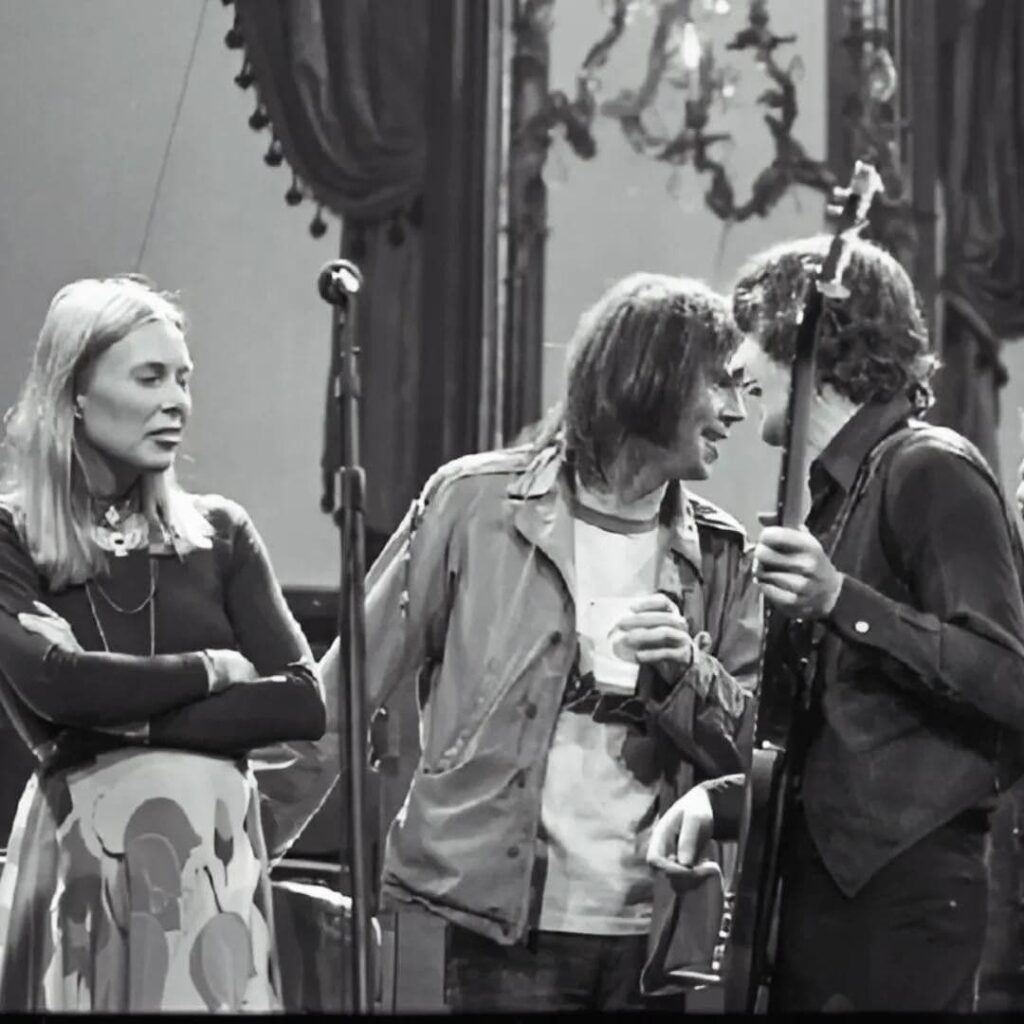
A bright, deceptively cheerful warning about loss, memory, and the cost of progress hidden inside a pop melody that never stopped echoing
Few songs in popular music history sound as carefree as “Big Yellow Taxi”, yet few carry such a quietly devastating message. Written, performed, and first released by Joni Mitchell in 1970 on the album Ladies of the Canyon, the song arrived at a moment when folk music was turning inward and outward at the same time—personal confession on one hand, social awakening on the other. Upon its release, “Big Yellow Taxi” climbed to No. 24 on the U.S. Billboard Hot 100, while reaching No. 6 on the UK Singles Chart, an impressive feat for a song that openly challenged the direction of modern life rather than comforting it.
What made its chart success remarkable was not just the melody, but the message hidden beneath it. On the surface, the song feels almost playful: bright acoustic guitar, a lilting rhythm, and Mitchell’s unmistakable voice delivered with a lightness that borders on ironic. Yet behind that breezy exterior lies a stark reflection on environmental destruction, urban expansion, and the human habit of realizing value only after something is gone. This contrast—sunshine music paired with unsettling truth—is precisely what gives “Big Yellow Taxi” its lasting power.
The story behind the song is as revealing as its lyrics. Mitchell has often explained that the idea came to her during a trip to Hawaii. Looking out from her hotel room, she saw a vast parking lot stretching across what had once been natural land. That image stayed with her. The line “they paved paradise and put up a parking lot” was not metaphorical flourish—it was direct observation. In that sense, “Big Yellow Taxi” belongs to a tradition of songwriting rooted in witnessing, much like folk songs of earlier decades that documented social change through simple, human images rather than grand declarations.
The song’s meaning unfolds through a series of small, almost casual losses: trees cut down, birds disappearing, green spaces replaced by concrete. There is no anger shouted here, no raised fist. Instead, Mitchell sings with a tone of mild disbelief, as if still hoping someone might stop and reconsider. That restraint is crucial. It allows the song to age gracefully, never locking itself into the slogans of a specific era. Even today, decades later, the lyrics feel uncomfortably current.
Perhaps the most haunting line—“you don’t know what you’ve got till it’s gone”—has since entered the cultural bloodstream, quoted and reused endlessly. Yet in its original context, it is not a cliché but a confession. Mitchell places herself inside the problem, not above it. The final verse, often interpreted as a lighthearted comment on personal freedom, subtly reinforces the larger theme: systems that promise convenience and progress often come with unseen costs, whether environmental or emotional.
Musically, “Big Yellow Taxi” marked an important moment in Joni Mitchell’s evolution. Coming after the more intimate storytelling of earlier work, it showed her ability to fuse sharp social commentary with pop accessibility. Ladies of the Canyon itself would become one of her defining albums, balancing introspection with observation, personal reflection with communal concern. In retrospect, the album feels like a turning point not just for Mitchell, but for singer-songwriters who followed—artists who learned that serious ideas did not have to sound heavy to be effective.
Over the years, “Big Yellow Taxi” has been covered, rearranged, and reinterpreted countless times, yet the original recording remains definitive. There is something about Mitchell’s phrasing—slightly off-center, conversational, almost smiling—that makes the warning feel intimate rather than preachy. It sounds less like a lecture and more like a memory being shared, tinged with regret.
For listeners who have lived long enough to see landscapes change, neighborhoods disappear, and familiar places replaced by anonymous structures, the song resonates deeply. It does not demand action; it invites reflection. And in that invitation lies its quiet strength. “Big Yellow Taxi” endures because it understands something fundamental about time: that progress often moves faster than wisdom, and that songs, like memories, sometimes exist to remind us of what we once had—and what we might still choose to protect.