
Fear, Desire, and the Quiet Bravery of Loving Without Armor
Few songs in early 1960s popular music capture emotional tension with the precision and restraint of Running Scared. Recorded by Roy Orbison for Monument Records and released in 1961, the song arrived not as a loud declaration but as a tightly coiled confession. It reached No. 1 on the Billboard Hot 100 in the United States, confirming that an audience accustomed to swagger and bravado was ready to listen to vulnerability when it was expressed with conviction and craft. Written by Roy Orbison and Joe Melson, Running Scared remains one of the most daring hit records of its era, both musically and emotionally.
At the top of its success, Running Scared stood apart from the prevailing rock and pop formulas. There is no chorus in the conventional sense. There is no instrumental solo designed to show off a band. Instead, the song unfolds like a short psychological drama. The narrator is not running from danger in the physical sense, but from the fear of losing love. This quiet panic is the engine of the song. Orbison does not shout it. He allows it to rise slowly, patiently, until the final moment when the tension breaks.
Musically, Running Scared is built on a bolero-inspired structure, a slow, measured rhythm that gradually intensifies. The arrangement is famously sparse at the beginning, giving Orbison’s voice an almost theatrical isolation. As the song progresses, the instrumentation subtly accumulates, mirroring the growing anxiety in the lyrics. The final key change upward, one of Orbison’s signature devices, is not decorative. It is emotional necessity. When Orbison reaches the climactic line, his voice soaring into an exposed upper register, it feels earned, even inevitable. Few pop records of the time trusted silence and restraint so completely.
Lyrically, Running Scared tells a simple story, but simplicity is its strength. The narrator fears a rival who is stronger, more confident, more capable of offering security. This fear is not masked by pride. It is openly admitted. In an era when male vocalists often projected certainty, Orbison sang doubt. That honesty resonated deeply, particularly with listeners who understood that love is rarely fearless. The final revelation, when the woman chooses to stay, does not feel like a triumph over another man. It feels like a moment of grace.
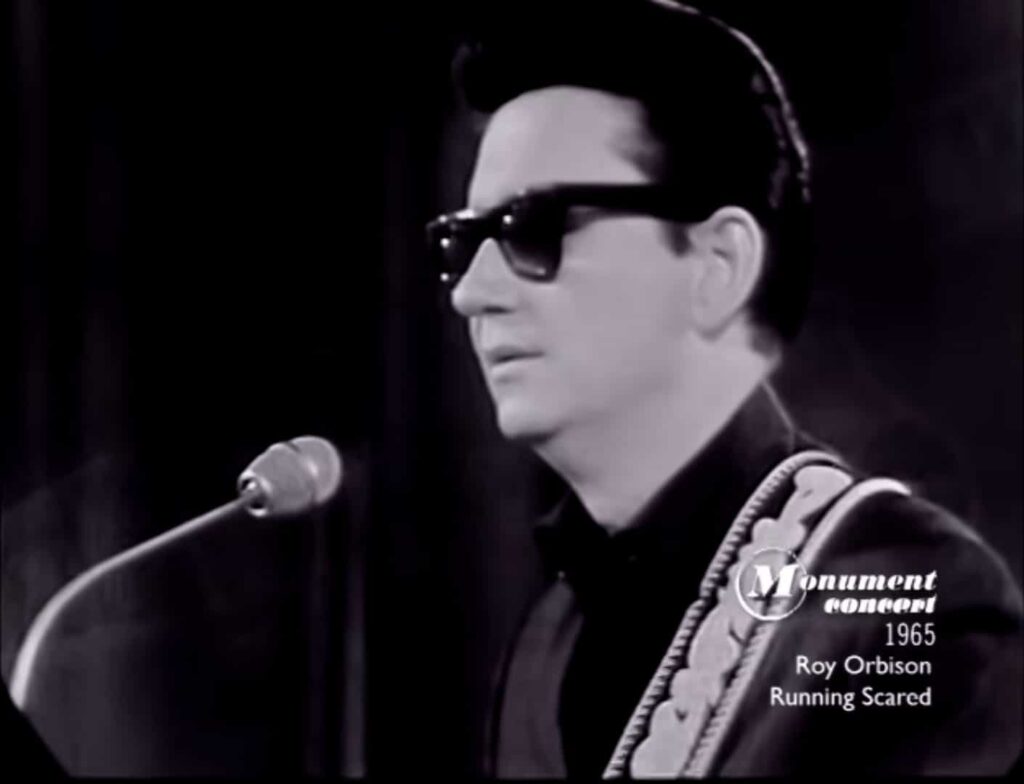
The song’s inclusion in Roy Orbison’s live performances during his Monument Records years, including concerts around 1965, reinforced its power. On stage, Orbison stood nearly motionless, allowing the song’s architecture to do the work. Without exaggerated gestures or visual spectacle, he held audiences through vocal control alone. This approach was unusual at the time and quietly revolutionary. It suggested that emotional authority did not require volume or movement, only truth delivered without compromise.
Running Scared later appeared on the album Crying released in 1962, further solidifying its place within Orbison’s most influential body of work. Alongside songs like Crying and Dream Baby, it defined a period when Orbison transformed pop music into a space for adult emotion, where longing, fear, and devotion could coexist without irony.
For listeners who came of age with this music, Running Scared often feels less like a song and more like a remembered feeling. It recalls a time when records were built patiently, when silence mattered, and when a voice alone could carry the weight of an unspoken life. Its success on the charts mattered, but its endurance matters more. Decades later, the song still speaks to those who understand that love’s greatest risk is not rejection, but the courage required to admit how much one cares.
In the canon of classic popular music, Roy Orbison remains singular. Running Scared stands as one of his quiet monuments, a reminder that strength in music, as in life, often reveals itself through restraint rather than force.
 Oldies Songs