
A Quiet Conversation About Love That Never Fully Learned How to Stay
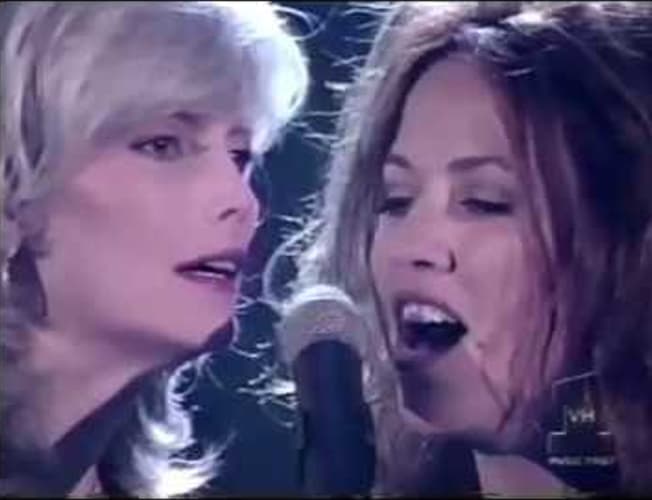
When Sheryl Crow and Emmylou Harris stepped onto the stage together to perform “Pale Blue Eyes” live, they were not chasing charts, radio spins, or modern relevance. They were engaging in something far rarer in popular music a shared act of remembrance. The song itself did not originate with them. “Pale Blue Eyes” was written by Lou Reed and first released in 1969 on The Velvet Underground album The Velvet Underground. At the time of its release, the album did not chart on the Billboard 200, and the song itself was never issued as a commercial single. Yet history has been kinder than the charts ever were. Over decades, the song has grown into one of Reed’s most quietly devastating compositions.
The importance of “Pale Blue Eyes” lies precisely in what it does not do. It does not shout. It does not explain itself fully. It does not seek closure. Lou Reed wrote the song during a period of emotional entanglement and quiet disillusionment, widely understood to be inspired by a relationship that existed in the shadows, constrained by circumstance and choice. Reed never confirmed a single definitive backstory, but he acknowledged that the song reflected personal experience rather than fiction. The lyric unfolds like a late night confession spoken too softly to interrupt the silence of the room.
Musically, the original recording is restrained to the point of fragility. There is no dramatic crescendo, no lyrical payoff that redeems the ache. The melody moves gently, almost hesitantly, allowing the words to carry their weight without ornament. It is this emotional openness that has made “Pale Blue Eyes” a song artists return to not to reinterpret, but to inhabit.
That is exactly what happens when Sheryl Crow and Emmylou Harris perform it live. Their collaboration is not about blending styles so much as blending histories. Emmylou Harris, long revered for her crystalline voice and her devotion to songcraft, approaches the lyric with lived in patience. She understands restraint as a form of honesty. Sheryl Crow, whose career bridges roots rock, folk, and Americana, brings warmth and conversational intimacy rather than polish. Together, they do not modernize the song. They humanize it.
This live performance never entered any chart and was never intended to. Its value lies in its atmosphere. Two voices, seasoned by time, stand in quiet alignment with a song that has always belonged to the margins. The absence of commercial ambition allows the emotional truth to surface more clearly. The pauses between lines matter as much as the words themselves. Each verse feels like a memory being revisited carefully, without the expectation that it will feel better the second time.
The meaning of “Pale Blue Eyes” remains elusive because it mirrors real emotional life. Love exists. Desire persists. But circumstances remain unmoved. The song does not ask for sympathy. It simply records the fact of longing and the cost of accepting less than what the heart quietly wants. Lines like “It was good what we did yesterday” resonate not as nostalgia, but as resignation. Happiness is recalled, not reclaimed.
For listeners who have lived long enough to recognize the difference, this performance speaks with particular clarity. It understands that some relationships are not meant to be resolved, only remembered. Sheryl Crow and Emmylou Harris do not attempt to resolve them either. They let the song remain unfinished, just as Lou Reed left it.
In the end, “Pale Blue Eyes” endures because it respects silence. It respects the private corners of memory. And in this live collaboration, the song becomes less about youth or loss, and more about acknowledgment. Some love stories do not end. They simply stop asking to be explained.