
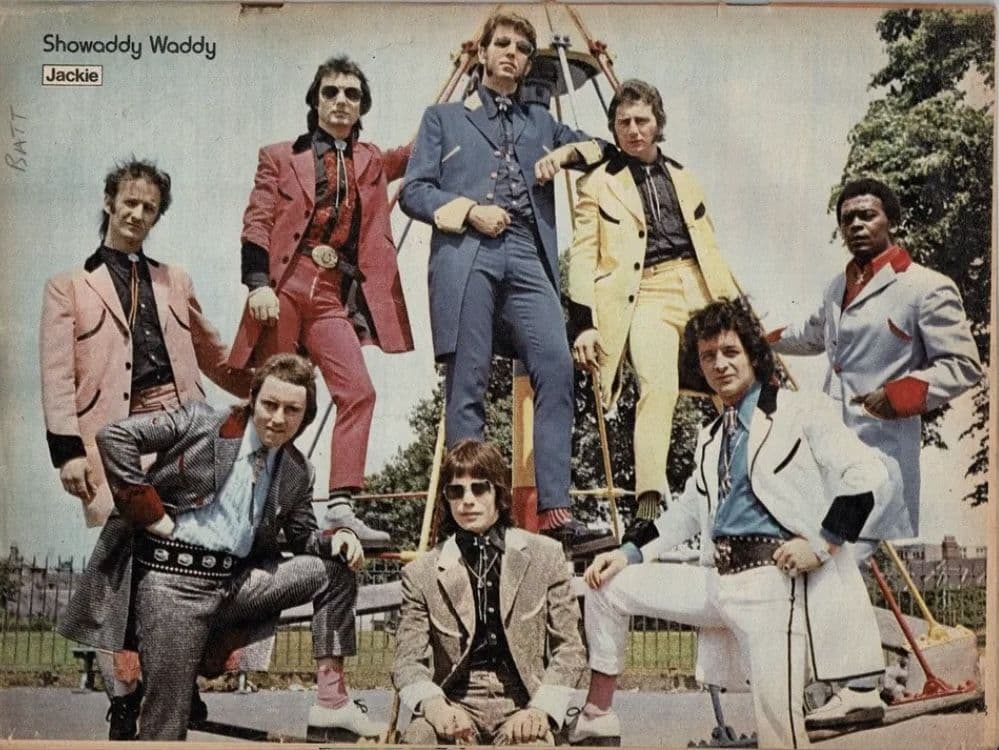
Hey Rock And Roll — a joyful revival of youthful rhythm, hand-claps, and memories that never grow old
From the very first shout of its title, “Hey Rock And Roll” by Showaddywaddy bursts open like a time capsule — releasing the raw excitement of jukeboxes, dance halls, Brylcreem hair, and nights when music felt like freedom itself. Released in late 1973 and rising to prominence in early 1974, the song became one of the band’s defining moments, climbing to No. 2 on the UK Singles Chart and remaining there for several weeks. Though it never quite reached the top spot, its cultural impact has proven far more enduring than many chart-toppers of its era.
Showaddywaddy, formed in Leicester, were part of a broader 1970s rock-and-roll revival movement, but “Hey Rock And Roll” was more than a nostalgic exercise. It was a declaration. At a time when progressive rock, glam excess, and studio complexity dominated the airwaves, this song unapologetically stripped everything back to rhythm, harmony, and joy. It reminded listeners that rock and roll was never meant to be complicated — it was meant to be felt in the body.
The song itself is built on a pounding beat, handclaps that beg for participation, and group vocals that sound like a gang of friends singing from the corner of a dance floor. There is no elaborate metaphor, no hidden agenda. Instead, the lyrics celebrate rock and roll as a living force — something that moves through generations, through changing fashions, refusing to disappear. When the chorus hits, it doesn’t ask permission; it demands you join in.
Behind the scenes, “Hey Rock And Roll” captured the essence of Showaddywaddy’s identity. With multiple lead singers and strong doo-wop-influenced harmonies, the band consciously evoked the spirit of 1950s American rock while delivering it with 1970s energy. This blend proved irresistible. For many listeners, the song felt both familiar and fresh — like hearing an old favorite for the first time all over again.
What gives “Hey Rock And Roll” its lasting power is not just its sound, but its attitude. There is a sense of defiance woven into its joy. In celebrating rock and roll so openly, the song pushes back against the idea that music — or people — must age out of excitement. It insists that the urge to dance, to clap, to lose oneself for three minutes never truly fades. That message resonated deeply with those who had lived through the original rock-and-roll explosion of the 1950s and now found themselves older, wiser, yet still moved by the same rhythms.
Listening today, the track carries an extra layer of meaning. It doesn’t just celebrate rock and roll as a genre; it celebrates memory itself. Every beat seems to echo with images of crowded halls, spinning records, and laughter carried late into the night. The song becomes a reminder of who we were when music first made our hearts race — and who we still are when we let it.
Unlike songs weighed down by nostalgia, “Hey Rock And Roll” feels alive. It doesn’t look backward with sadness, but with gratitude. It says: this mattered, this still matters, and it always will. That is why it continues to be played, sung, and smiled at decades later.
In the legacy of Showaddywaddy, this song stands as a banner held high — a simple, exuberant affirmation that rock and roll is not confined to a decade or a chart position. It lives wherever people still tap their feet, clap their hands, and remember the thrill of hearing a song that made the world feel young again.