
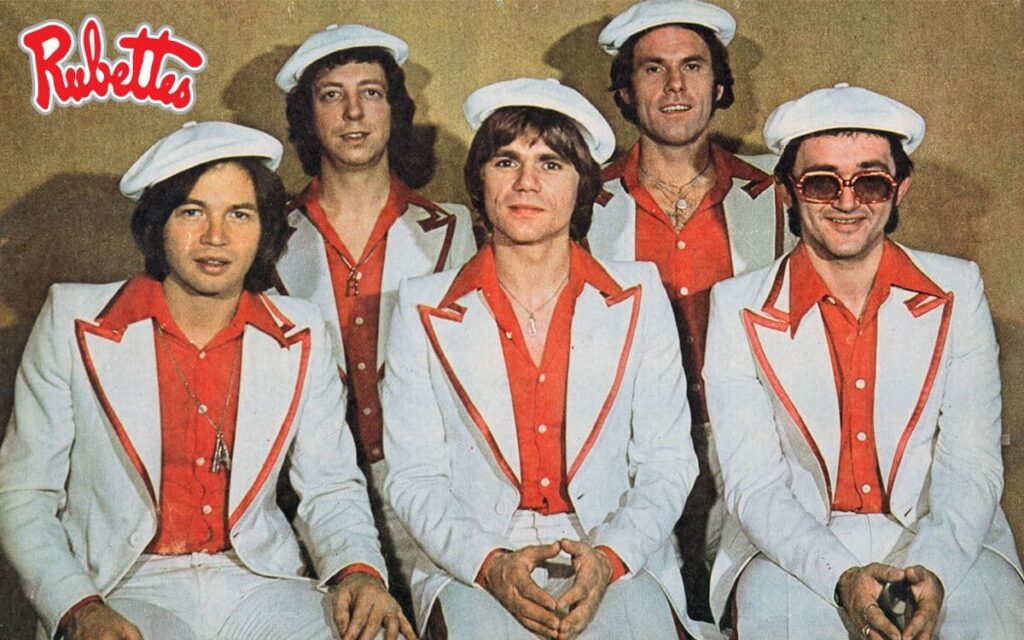
Tonight — a fleeting promise of young love, wrapped in harmony and moonlight
When The Rubettes released “Tonight” in 1974, it arrived like a soft echo after a thunderclap. The thunder, of course, had been “Sugar Baby Love,” the song that carried them to the top of the charts and etched their falsetto harmonies into popular memory. “Tonight” did not aim to repeat that explosion. Instead, it chose a gentler path — one paved with romance, hesitation, and the fragile hope that everything meaningful might still happen before morning comes.
Right from the start, some important context matters. “Tonight” was released as a single in 1974 and reached the UK Top 20, peaking at No. 12. While it did not conquer the charts the way its predecessor had, its success confirmed that The Rubettes were more than a novelty of doo-wop revival. They were storytellers of youth, capable of shaping emotion with melody and harmony rather than sheer chart momentum.
Musically, “Tonight” leans deeply into nostalgia. The song draws from the golden age of early-1960s pop and doo-wop, a style already fading by the mid-1970s, yet lovingly preserved by The Rubettes. Layered harmonies glide gently over a restrained rhythm, allowing the lead vocal to float with an almost trembling sincerity. There is no rush here — just anticipation, like waiting for a door to open or a phone to ring.
Lyrically, the song is disarmingly simple, and that simplicity is its strength. Tonight is not about lifelong promises or dramatic declarations. It is about the immediacy of feeling — the belief that this night, of all nights, might finally be the one where love speaks back. The singer stands on the edge of uncertainty, hoping that what he feels is shared, that the silence will break, that closeness will replace doubt.
That sense of emotional suspension is what gives the song its lasting power. Everyone knows that feeling — the moment before something changes, when the heart races faster than logic. The Rubettes captured that moment perfectly. The falsetto lines do not sound triumphant; they sound hopeful, almost fragile, as if love itself could disappear if handled too roughly.
Behind the scenes, “Tonight” also reflects a transitional moment for the group. After the overwhelming success of “Sugar Baby Love,” expectations were immense. Rather than chase a louder or more extravagant follow-up, The Rubettes leaned inward. They trusted harmony, restraint, and emotional honesty. In doing so, they created a song that feels intimate even when played on the radio — as though it were meant for quiet listening rather than celebration.
For listeners who lived through that era, “Tonight” often carries personal associations. It recalls evenings spent near a radio, the soft glow of streetlights, the nervous excitement of youth when everything felt possible and uncertain at once. The song does not shout those memories into existence; it gently invites them back.
Time has been kind to “Tonight.” Freed from the pressure of charts and trends, it now feels like a preserved moment — a musical photograph slightly faded at the edges, yet warm to the touch. It reminds us of a period when pop music could be tender without irony, emotional without excess, and sincere without explanation.
In the broader story of The Rubettes, “Tonight” stands as a quiet counterbalance to their biggest hit. It may not define them in headlines, but it reveals their heart. And for those willing to listen closely, it offers something rare: the sound of hope, suspended in harmony, waiting patiently for love to answer — just for tonight.