
A Ballad of Betrayal, Brotherhood, and the Quiet Price of Survival
When “Pancho and Lefty” was first released in 1972 on Townes Van Zandt’s album The Late Great Townes Van Zandt, it did not climb the pop charts, nor did it receive the kind of commercial recognition that defines a hit. Yet time has a way of correcting such oversights. The song would later reach No. 1 on the Billboard Hot Country Singles chart in 1983 when recorded by Willie Nelson and Merle Haggard, bringing long-overdue attention to its author. But in its original form—quiet, spare, and haunting—it remains one of the most profound pieces of American songwriting ever recorded.
Written by Townes Van Zandt, one of the most revered yet tragically underappreciated figures in folk and country music, “Pancho and Lefty” tells the story of a Mexican bandit, Pancho, and his companion, Lefty. The song unfolds like a weathered photograph—faded at the edges, but painfully vivid at its center. We are told that Pancho “needed your prayers, it’s true,” and that he ultimately “died in the desert down in Mexico.” Lefty, meanwhile, survives—but survival comes at a cost. He lives on in Cleveland, “all the Federales say they could have had him any day,” yet they let him slip away. It is strongly implied that Lefty betrayed Pancho to save himself.
The beauty of the song lies not in explicit storytelling but in suggestion. Van Zandt never states outright that Lefty betrayed his friend. Instead, he lets the silence between the lines do the talking. That restraint—so rare and so dignified—is part of what gives the song its enduring emotional weight. It is a meditation on loyalty, compromise, regret, and the complicated nature of friendship.
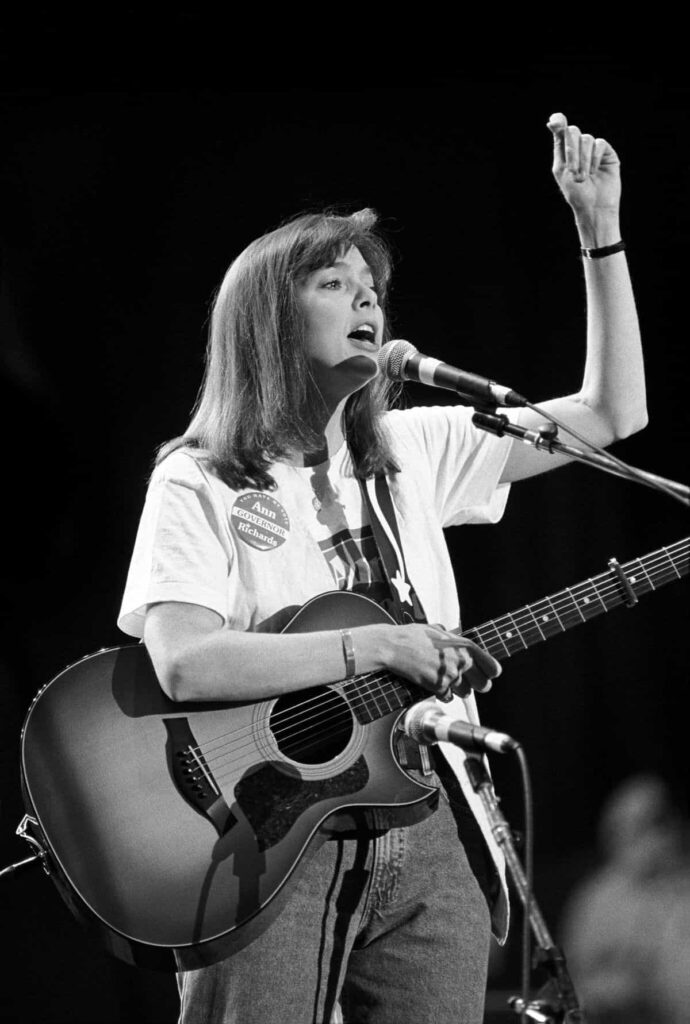
When Nanci Griffith performed “Pancho and Lefty,” she brought a different but equally reverent sensibility to the song. Griffith, a devoted admirer of Van Zandt, often championed his work throughout her career. Her interpretation did not seek to overshadow the original but to illuminate it. With her clear, plaintive voice, she emphasized the song’s loneliness and moral ambiguity. Griffith understood, perhaps instinctively, that this was not merely a tale of outlaws, but a quiet elegy for lost ideals.
The early 1970s were not kind to Van Zandt commercially. Despite releasing a string of extraordinary albums, including Our Mother the Mountain (1969) and Delta Momma Blues (1971), he remained a songwriter’s songwriter—admired deeply by peers such as Emmylou Harris, Kris Kristofferson, and later generations of Americana artists, but rarely rewarded with mainstream success. It was only after Nelson and Haggard’s chart-topping rendition that the wider public began to recognize the depth of his craft.
Yet chart positions, while important, tell only part of the story. “Pancho and Lefty” has endured because it speaks to something timeless. It asks uncomfortable questions: What is loyalty worth? What does survival cost? Is it better to die a legend, or to live with compromise? The song never answers these questions directly. Instead, it leaves them lingering, like desert wind across an empty plain.
Musically, the original recording is spare—acoustic guitar, restrained accompaniment, and Van Zandt’s soft, almost conversational vocal delivery. There is no grand orchestration, no dramatic flourish. The power lies in understatement. Each verse feels like a memory shared late at night, when the world has grown quiet and reflection becomes unavoidable.
Over the decades, “Pancho and Lefty” has been covered by numerous artists, but its essence remains rooted in Van Zandt’s singular voice. Nanci Griffith’s association with the song reflects her lifelong dedication to preserving and celebrating the work of great American songwriters. She did not simply perform songs; she carried them forward like heirlooms.
In the end, “Pancho and Lefty” is not just a story about two men on the run. It is about the fragile nature of human bonds, about the stories we tell ourselves to live with our choices, and about the thin line between heroism and regret. It reminds us that legends often burn brightly—and briefly—while ordinary lives stretch on, shadowed by memory.
And perhaps that is why the song continues to resonate so deeply. Because beneath its dusty imagery and border-town folklore lies a truth that feels quietly familiar: that every life holds its own Pancho and Lefty—its moments of courage, its moments of compromise—and its long, reflective aftermath.
 Oldies Songs