
A Quiet Confession of the Heart, Where Love Survives Only in Memory an
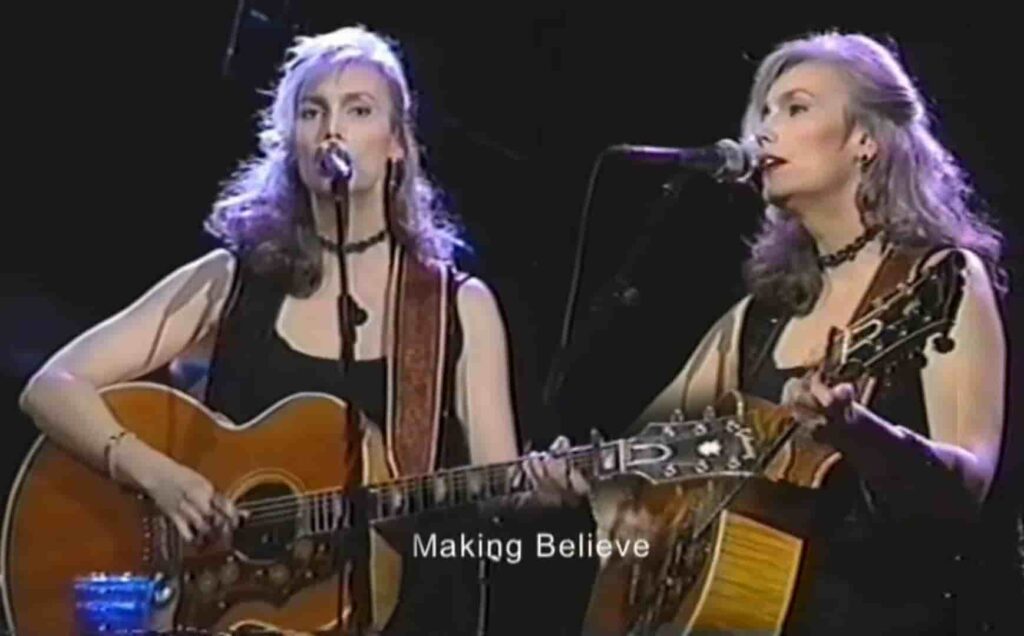
When Emmylou Harris steppeRyman Auditorium oThe, she“Making Believe” stood out as a moment of hushed reverence, a song that seemed to breathe with the walls of the Ryman itself.
Originally written and recorded in 1955 by Jimmy Work, “Making Believe” has long been regarded as one of the purest expressions of unfulfilled love in the country music canon. The song’s first major success came later that same year when Kitty Wells recorded her version, which climbed to No. 2 on the Billboard Hot Country Songs chart. At the time, it resonated deeply with listeners who understood longing not as drama, but as a quiet, private ache. The song did not shout its sorrow; it simply lived with it.
By the time Emmylou Harris revisited “Making Believe” four decades later, its emotional gravity had only deepened. Her performance was recorded live for the album “At the Ryman”, released in 1995, a project that marked both a creative renewal and a personal return to roots. Though her rendition was not released as a single and therefore did not enter the charts, its significance lies elsewhere. It belongs to the realm of legacy, interpretation, and emotional truth rather than commercial metrics.
Harris’s voice on that night is restrained, almost fragile, yet unwavering. She does not embellish the melody or modernize the arrangement. Instead, she allows the song’s simplicity to speak for itself. Backed by acoustic instruments and the gentle harmonies of the Nash Ramblers, the performance feels intimate, as though overheard rather than presented. This approach honors the song’s original spirit while allowing Harris’s lived experience to quietly inform every phrase.
The meaning of “Making Believe” is deceptively simple. It tells the story of loving someone who belongs to another, and of surviving by pretending that love might someday be returned. There is no bitterness, no accusation, only acceptance. In Harris’s hands, the song becomes less about romantic longing and more about the human habit of clinging to hope, even when reason advises otherwise. It speaks to the moments in life when pretending is not denial, but survival.
What makes this rendition especially powerful is its setting. The Ryman Auditorium, often called the Mother Church of Country Music, carries its own emotional weight. Harris had first stood on that stage as a young singer in the late 1960s, uncertain of her place in the world. Returning there in 1995, seasoned by loss, success, and reflection, she sang “Making Believe” not as a character, but as a witness to time. The audience did not simply listen; they remembered.
The album “At the Ryman” would go on to win two Grammy Awards and is widely considered one of Harris’s finest works. Yet “Making Believe” remains one of its most understated moments. It does not demand attention. It invites reflection. For listeners who have lived long enough to understand that some loves are never meant to be fulfilled, the song feels less like a performance and more like a quiet acknowledgment.
In the end, “Making Believe” endures because it understands something fundamental about the human heart. Some feelings never fade; they simply learn to live quietly within us. Through Emmylou Harris, this old country standard was not revived, but gently carried forward, reminding us that pretending can sometimes be the most honest thing we do.