
A Vow of Solitude and Freedom, Sung with Quiet Resolve and Shared Understanding
When “I Never Will Marry” is mentioned, it rarely appears beside chart statistics or commercial triumphs. Yet its power lies precisely in that absence. This is a song that endured not because it conquered the charts, but because it spoke honestly to listeners who understood that love, once broken deeply enough, can reshape a life forever. Performed memorably by Linda Ronstadt and Johnny Cash, the song stands as one of the most restrained, dignified statements in American folk and country music.
“I Never Will Marry” is a traditional folk song with roots reaching back into the 19th century, long before the age of radio singles or Billboard rankings. Because of its traditional status, it was never released as a commercial single and therefore did not enter any major music charts at the time of its modern performances. That fact is important. This song was never meant to compete. It was meant to be confessed.
Linda Ronstadt first brought renewed attention to the song on her 1969 debut solo album Hand Sown… Home Grown, recorded during a period when she was still searching for her artistic identity. At that point, Ronstadt was transitioning from folk-rock collaborations into a more personal and emotionally exposed style. Her version of “I Never Will Marry” was spare and unadorned, allowing the weight of the lyric to stand on its own. The narrator does not curse love. She simply steps away from it, choosing solitude over repeated heartbreak.
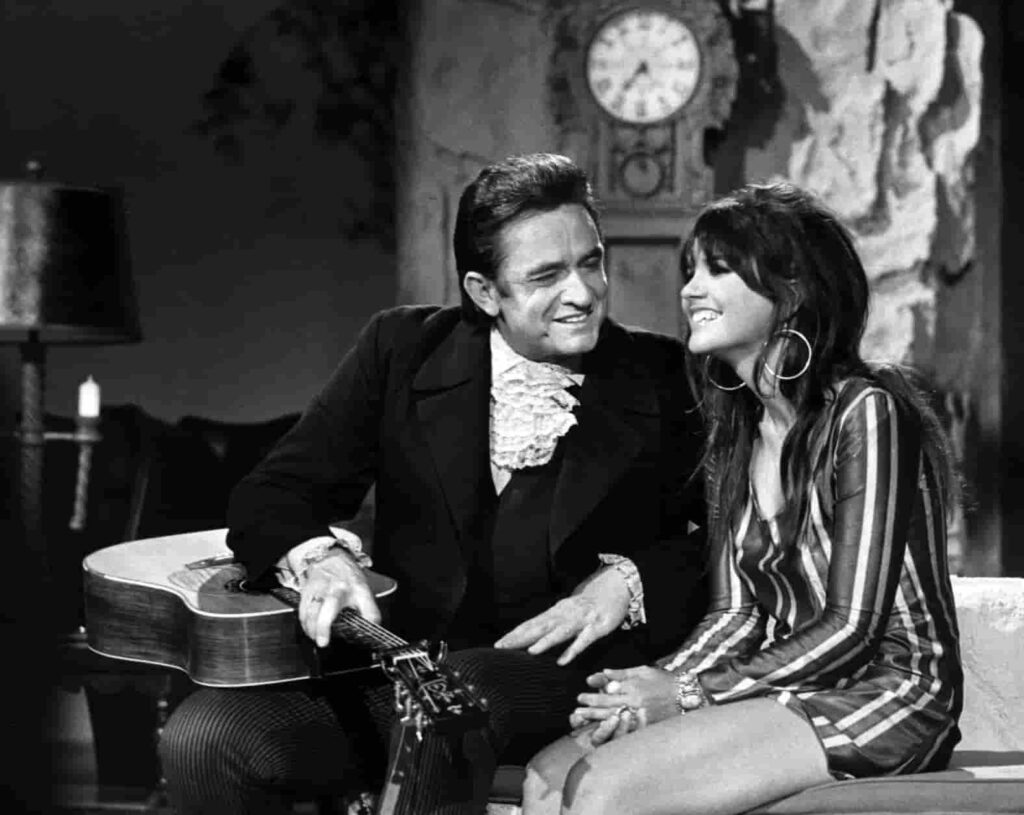
The duet with Johnny Cash, performed on The Johnny Cash Show, added another layer of meaning. Cash, already a towering figure in American music by the late 1960s, approached the song not as a young romantic, but as a man who had lived through addiction, loss, and redemption. His voice carried gravity and restraint, shaped by years of personal struggle. When paired with Ronstadt’s clear, emotionally direct delivery, the song became a quiet conversation between two souls who understood pain without needing to dramatize it.
The story behind “I Never Will Marry” is not about scandal or spectacle. It is about emotional self-preservation. The lyrics tell of repeated betrayals and promises broken so often that hope itself becomes dangerous. The decision not to marry is not framed as bitterness, but as wisdom earned the hard way. In this sense, the song reflects an older worldview, one shaped by experience rather than idealism. It acknowledges that love can be profound, but it can also wound beyond repair.
For Johnny Cash, the song aligned naturally with themes that ran throughout his career: moral reckoning, consequence, and quiet endurance. He never oversang it. He never tried to dominate it. Instead, he let the words exist, trusting that listeners would recognize their truth. For Linda Ronstadt, the song revealed an emotional seriousness that foreshadowed her later mastery of ballads and torch songs, long before superstardom arrived with albums like Heart Like a Wheel.
Musically, the song’s simplicity is its strength. There are no dramatic crescendos, no instrumental flourishes demanding attention. The melody moves gently, almost cautiously, as if aware that too much beauty might undermine the honesty of the message. The restraint invites reflection rather than reaction.
Over time, “I Never Will Marry” has come to represent something rare in popular music: a mature acceptance of emotional limits. It does not celebrate loneliness, nor does it romanticize suffering. Instead, it acknowledges a moment when a person chooses peace over longing, clarity over hope. That choice, quietly sung by Linda Ronstadt and Johnny Cash, continues to resonate because it respects the listener’s intelligence and lived experience.
In the end, the song endures not as a hit, but as a truth. One spoken softly, without bitterness, and remembered long after louder songs have faded.