
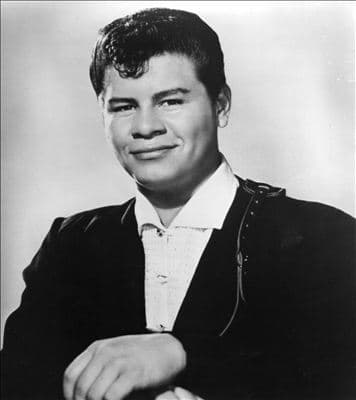
A Tender Lament from a Life Cut Short, Where Young Love Turns into Eternal Echo
On September 23, 1958, inside the legendary Gold Star Recording Studios in Los Angeles, a young man barely seventeen stepped up to the microphone and delivered a performance that still feels intimate decades later. The song was “Now You’re Gone”, recorded by Ritchie Valens, and later released in 1959 on his posthumous second album, Ritchie. By the time the album appeared in stores, Valens had already been gone for months, lost in the tragic plane crash of February 3, 1959, alongside Buddy Holly and J.P. “The Big Bopper” Richardson. The single itself did not chart nationally on the Billboard Hot 100 upon release, overshadowed by the seismic impact of “Donna”, which had reached No. 2, and the groundbreaking “La Bamba”, which climbed to No. 22. Yet history has a way of preserving quieter songs for deeper listening.
“Now You’re Gone” stands apart from the teenage exuberance that often defined late-1950s rock and roll. Where “La Bamba” pulsed with cultural pride and rhythmic urgency, and “Come On, Let’s Go” crackled with youthful invitation, this ballad withdraws into solitude. It opens with a tone of emotional stillness, almost fragile in its restraint. The lyric line, “Well now, I’m sittin’ here alone, wondering what I’ll do,” carries a simplicity that speaks volumes. There is no ornamentation in the phrasing. No theatrical excess. Just the plain confession of a heart stunned by absence.
Musically, the track leans into early R&B-inflected rock balladry, structured around a slow tempo and gentle rhythmic sway. The chord progression follows a classic 1950s pattern, allowing the melody to breathe without distraction. What elevates the performance is Valens’ vocal timbre. His voice, though youthful, carries an almost preternatural smoothness. There is control in his vibrato, but also a tremor of vulnerability that feels unguarded. He does not oversing. Instead, he inhabits the lyric, allowing pauses to linger just long enough to suggest thoughts left unfinished.
By the time Ritchie was released in 1959, the listening public was still reeling from the loss of one of rock and roll’s most promising pioneers. Valens had already made history as one of the first Mexican American artists to achieve mainstream success in American rock music. That context deepens the emotional resonance of “Now You’re Gone.” The song becomes, unintentionally, more than a teenage heartbreak lament. It begins to feel like a farewell whispered from beyond a closed door.
The production at Gold Star bears the hallmarks of the era. The studio, famous for its echo chamber, gives the recording a subtle spaciousness. There is a gentle halo around the vocal, not overwhelming, but enough to create the sensation of distance. Listening today, one hears not just a broken romance, but the atmosphere of a vanished time. The guitars are clean and understated. The rhythm section moves with quiet patience. Nothing rushes. Nothing intrudes.
It is tempting to imagine the young Valens recording this song without any notion of how short his journey would be. At seventeen, heartbreak feels immediate and immense. The emotional stakes are absolute. In that sense, “Now You’re Gone” captures the purity of early rock and roll before irony, spectacle, or self-conscious reinvention entered the genre. It is earnest. It believes in its own sadness.
For those who return to the music of the 1950s not merely for nostalgia but for emotional authenticity, this recording offers something enduring. The grief in the lyric mirrors a universal experience. Separation. Silence after shared laughter. The quiet room after someone leaves. These are themes that outlive charts and commercial metrics.
While “Now You’re Gone” never achieved the chart success of Valens’ bigger hits, its legacy lies elsewhere. It stands as a reminder that even in a career compressed into eight brief months of national prominence, there was depth beyond the radio singles. In the soft echo of that Gold Star session, one hears not only a young man mourning lost love, but a generation discovering that rock and roll could hold tenderness alongside rebellion.
And perhaps that is the true meaning of the song. Not simply the sorrow of a lover left behind, but the recognition that youth itself is fleeting. In that fragile voice, preserved on tape, there is a sincerity that time has not dimmed. The heartbreak he sang about was fictional. The loss that followed was not.
 Oldies Songs