
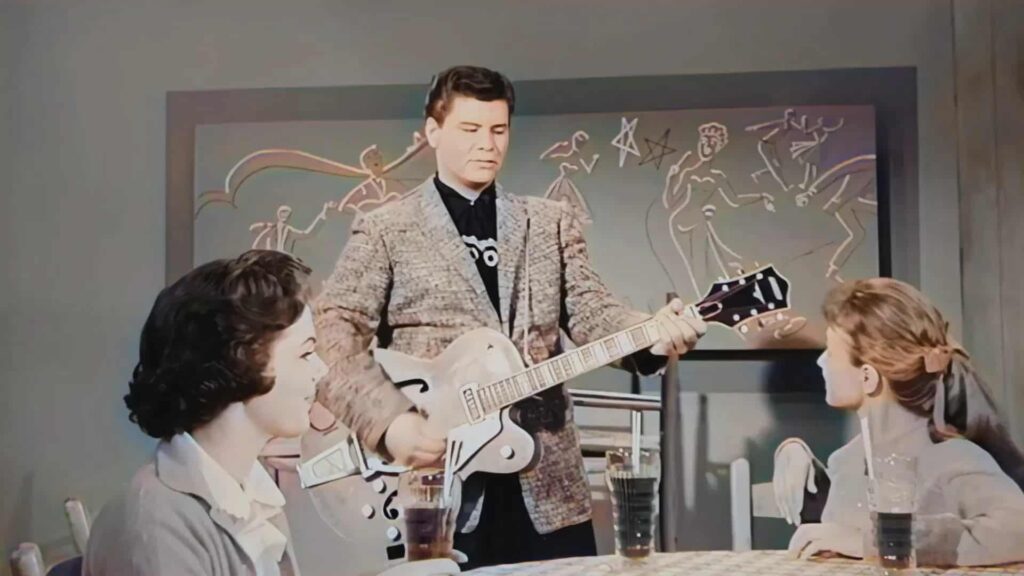
A Teenage Cry of Pure Rock and Roll Exuberance, Captured Before the Music Fell Silent
Released in 1959 as the B-side to “La Bamba,” “Ooh! My Head” by Ritchie Valens stands today as one of the most electrifying snapshots of early rock and roll. While “La Bamba” climbed to No. 22 on the Billboard Hot 100 and became a cultural milestone, “Ooh! My Head” did not chart independently. Yet history has a curious way of elevating songs beyond statistics. In the case of Ritchie Valens, whose life ended tragically on February 3, 1959 in the plane crash later remembered as “The Day the Music Died,” even a B-side can carry the force of legend.
Recorded for Del-Fi Records under the guidance of producer Bob Keane, “Ooh! My Head” is, at its core, a reworking of Little Richard’s “Ooh! My Soul.” The lineage is unmistakable. The pounding piano figures, the exuberant shouts, the call-and-response urgency all echo the architecture of 1950s rhythm and blues. Yet what distinguishes Valens’ performance is not imitation but youthful combustion. At just 17 years old, he infused the track with a breathless urgency that felt less rehearsed and more like a Saturday night bursting at the seams.
From the opening lines, the song barrels forward with almost reckless joy. The repeated exhortations to “rock all night” and the gleeful disregard for tomorrow capture the essential spirit of early rock and roll. This was music built for crowded dance halls, transistor radios pressed to teenage ears, and cars idling under neon lights. There is no philosophical reflection here, no poetic metaphor. Instead, “Ooh! My Head” offers something far more elemental: physical exhilaration. The cry “Ooh, my head” becomes both a comic complaint and a badge of honor, as if exhaustion itself were proof of having truly lived the night.
Listening closely, one hears how Valens’ vocal timbre differs from the giants he admired. Where Little Richard’s voice roared with gospel-fueled authority, Valens’ tone carried a lighter, almost boyish brightness. That brightness gave his recordings an immediacy that resonated deeply with audiences. He did not sound like a distant star. He sounded like the kid next door who had somehow tapped into electricity. In “Ooh! My Head,” that electricity crackles through every shouted phrase and percussive accent.
Historically, the song occupies a poignant position in Valens’ brief career. By early 1959, he had already demonstrated remarkable versatility. “Donna” had reached No. 2 on the Billboard Hot 100, revealing his gift for tender balladry. “La Bamba” bridged Mexican folk tradition and American rock in a way that was revolutionary for its time. Against those achievements, “Ooh! My Head” might seem like a minor footnote. Yet it serves as a reminder that Valens was not solely a crossover novelty or a sentimental crooner. He was, fundamentally, a rock and roll artist who understood the primal joy at the genre’s heart.
There is also an unspoken poignancy in hearing such exuberance from a voice that would soon fall silent. When Valens shouts “We gonna rock all night,” one cannot help but feel the bittersweet irony. The night, for him, was heartbreakingly short. And yet, perhaps that is why the song endures. It captures youth in its purest form, unburdened by caution, unconcerned with consequence.
In retrospect, “Ooh! My Head” stands as more than a B-side. It is an artifact from a formative moment in popular music, when rock and roll was still raw, still slightly dangerous, still thrillingly new. For those who remember that era, the song is not simply a recording. It is a doorway. The pounding rhythm, the shouted refrains, the sense of motion without restraint all evoke a time when music felt like a revolution carried on 45-rpm vinyl.
And when the final cry of “My head is tired” fades, what lingers is not fatigue but vitality. In less than three minutes, Ritchie Valens distilled the essence of rock and roll’s first great wave. The charts may not record its triumph, but the spirit of the performance tells its own story.
 Oldies Songs