
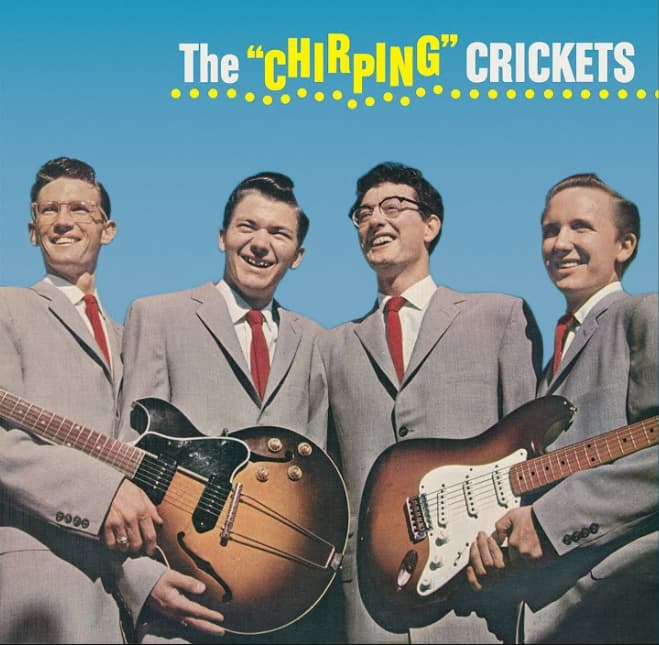
“Rock Me My Baby” — a little wild rock-and-roll spark from the early days of a legend
When I close my eyes and drift back to the 1950s, the jangle of guitar, the fresh energy of post-war youth, and the simple promise of rock and roll all swirl together in the last track of The “Chirping” Crickets Rock Me My Baby by Buddy Holly & The Crickets. Released in 1957, this song may not be the biggest hit on the record. Yet it carries a raw, joyful defiance, a restlessness that whispers of teenage longing and uncharted tomorrows.
✨ Origins and album placement
Rock Me My Baby was recorded by Buddy Holly and the Crickets during late September 1957 — specifically, in a makeshift session at the Officers’ Club of the Tinker Air Force Base in Oklahoma City.
It finally appeared as the twelfth and closing track on The “Chirping” Crickets, which was released on November 27, 1957 under the Brunswick label. This album was the only full-length record issued during Holly’s lifetime, making it a precious document of his earliest vision.
Despite the enduring appeal of several tracks on the album, The “Chirping” Crickets did not chart in the United States. In the United Kingdom, however, the album reached No. 5 in the album chart in April 1958 not long after Holly and the Crickets embarked on their first UK tour.
Interestingly, Rock Me My Baby was never released as a standalone single. It remained part of the broader tapestry of the album a hidden gem rather than a radio-ready hit.
🎸 The sound, the vibe, the story behind the track
Musically, Rock Me My Baby carries a brash, carefree spirit typical of early rockabilly. On this track, Holly’s lead guitar cuts through with a bright, slightly frantic energy. On drums is Jerry Allison, Joe Mauldin handles bass, and rhythm guitar comes from Niki Sullivan.
According to longtime rock historians, the verses ride on what feels like a “Bo Diddley beat,” while the chorus launches into a straight burn of rock and roll fire. The driving bass and upbeat tempo give the song a restless energy the kind that makes you want to dance, or at least tap your foot fast.
Behind the scenes, the session was somewhat unorthodox: the Crickets had been touring, and in a break between shows, the producer Norman Petty gathered the band at the base for a spontaneous late-night recording.
Because Rock Me My Baby was tucked away as the album’s closer, it never got the spotlight that hits like “That’ll Be the Day” or “Maybe Baby” did. Still, it showcases a side of Holly that was playful and willing to stretch the boundaries of rockabilly toward something more uninhibited.
💡 What this track means for its time and for us now
For listeners in the late 1950s, Rock Me My Baby sounded like youth itself. It didn’t carry grand ambition, social message, or deep heartbreak. Instead it offered a snapshot of a moment the jittery hope of teenage romance, the rough-and-ready thrill of guitars, the promise of nights spent dancing under dim lights.
For modern ears, especially those of us old enough to remember when rock and roll was young and rebellious, the track resonates as a small but bright spark from the dawn of a new musical age. It’s raw and unpolished, yes but in its rawness lies authenticity. In its simplicity lies sincerity.
In the context of the album and Holly’s brief career, Rock Me My Baby stands as a humble but essential piece. It rounds out The “Chirping” Crickets not with a grand hit, but with a wink, a shake, a night-time drive with the windows down. It reminds us that rock and roll wasn’t just about chart hits or record sales it was about feeling alive, feeling free, feeling in motion.
And for anyone revisiting the early days of rock, it’s a little secret from Buddy Holly: proof that even the “lesser” tracks carry magic.
🕰️ Final thoughts
Listening to Rock Me My Baby now, decades after it was recorded, I find myself drawn not just to the notes, but to the spirit behind them youthful, restless, hopeful. In a way, the track is like a postcard from another era: a time when rock and roll was new, unpredictable, full of possibilities.
Though it never charted or became a radio staple, Rock Me My Baby holds a quiet place in the tapestry of music history. It reminds us that every note, every riff, every crackling guitar string in those early days helped shape what popular music would become.
For those who grew up with rock in its infancy and for anyone willing to listen with heart as much as ears it remains a gentle yet stirring echo of a time when listening to a record felt like stepping into a promise of tomorrow.